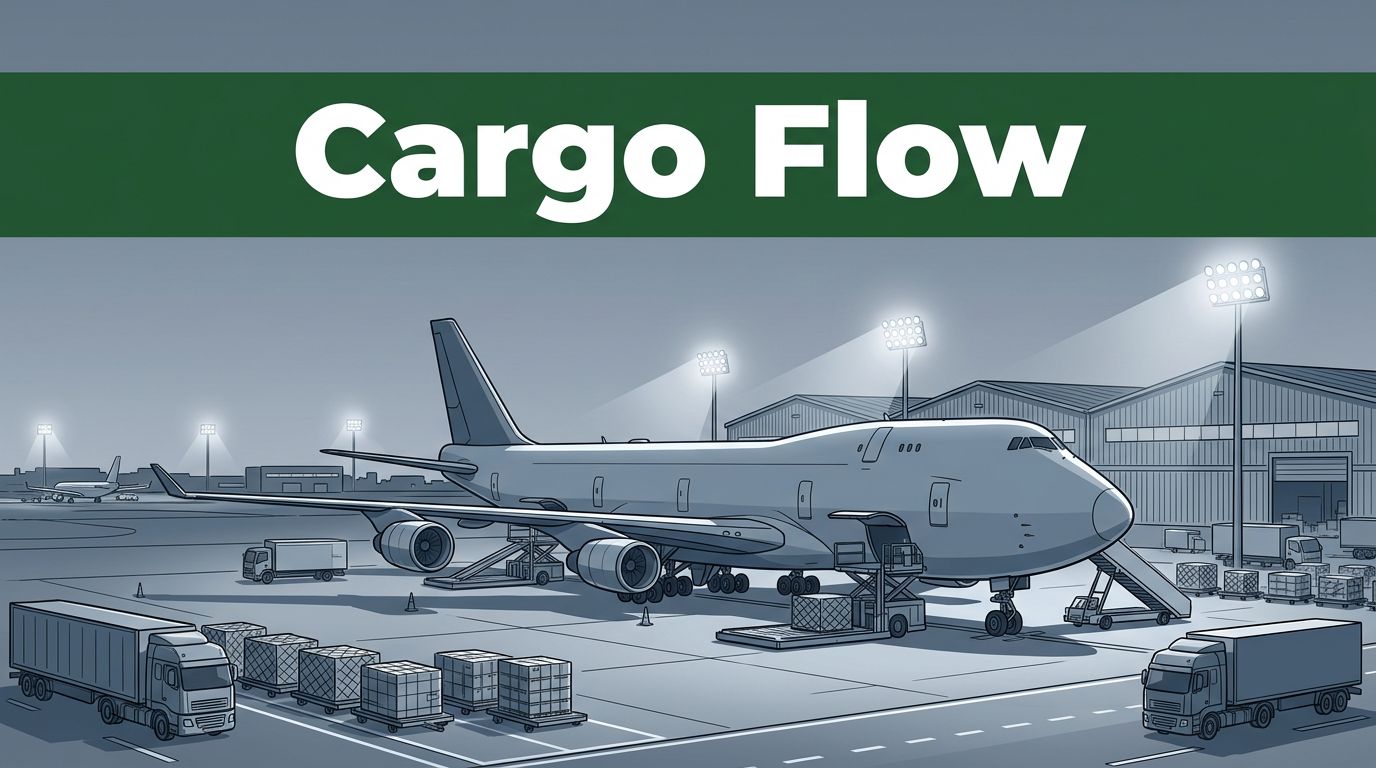
At 2:00 a.m., cargo terminals can look calm from the outside. Inside, the pace is relentless. Airports like Memphis, Hong Kong, and Shanghai Pudong keep millions of packages moving each night, mostly driven by e-commerce.
In early 2026, air cargo demand is up about 5%, and freighters now account for about 58% of capacity. That mix puts pressure on every step, from loading docks to customs holds.
The good news? Airports manage high volumes with a repeatable system: smart facilities, tight processes, the right tech, and trained teams. Here’s how it works, with real examples.
Cargo Facilities Built for Non-Stop Action
High-volume air cargo starts with the building layout. Terminals are designed like busy warehouses, not quiet storage lots. You’ll usually see three big zones next to each other: receiving, sortation, and aircraft loading.
Instead of moving items back and forth, airports use clear “flows.” Trucks enter, packages get checked, then they move to ULD areas (unit load devices). From there, the plan is simple: get pallets and containers onto ramps fast, before bottlenecks form.
Large hubs also run 24/7 operations or near it. That matters because cargo does not wait for daylight. For example, Memphis is known for heavy night processing tied to FedEx’s network. FreightWaves has reported on FedEx’s plans for a major sort center expansion at Memphis International Airport, aimed at handling more small-package volume tied to e-commerce growth (Memphis hub sort center expansion).
Hong Kong takes a different angle. With its Three-Runway System (3RS), the airport can support more flight capacity and smoother connections. That helps when sea-air shippers want to move goods quickly through the region instead of waiting for slower schedules. You can also see this “intermodal” focus in the way Hong Kong describes its sea-air cargo model (AAHK sea-air intermodal transshipment model).
Shanghai Pudong supports high volumes with a strong mix of capacity and specialized handling. E-commerce often means temperature-controlled freight, plus tight cutoffs. As a result, cargo planning there depends on both volume and handling type, not just total tons. PVG’s cargo terminal ecosystem is built to serve many airlines and forwarders through neutral terminal operations, described by PACTL (PVG cargo terminal capacity and operations).
Automated Sorting Hubs That Never Sleep
Automation is one reason top airports can absorb peaks without chaos. Many hubs rely on robotic sortation lines, powered conveyor systems, and AGVs (automated guided vehicles) that haul pallets and containers around the yard.
The core idea is simple. If a human has to carry every load, work stops when fatigue hits or staffing shifts end. Automation keeps moving even when the shift changes, because machines do the repetitive tasks.
In practice, sorting systems receive cargo, scan it, route it, and then stage it near the correct ramp. AGVs then move containers in short runs, so loading teams do less walking and more checking. Robotic arms can help too, especially when hubs pack or stage ULDs with tight consistency.
In 2026, near-term adoption trends still point toward more automation in “local” motion, like yard hauling and staged pallet movement. Airports also add more sensors, because automation needs clean inputs. If labels are messy or data is missing, machines still need humans to fix issues.
One more detail matters. High-volume hubs don’t just “add robots.” They tune the workflow around them, including the right staffing numbers for each shift. That’s how a sorting line stays fed, instead of waiting on trucks.
Storage Solutions for Every Type of Goods
Sorting is only half the story. The other half is what happens when freight can’t move immediately. That’s where storage design becomes a volume weapon.
Airports often separate areas by handling needs. You’ll see dedicated sections for:
- General cargo (most standard boxes and freight)
- Time-critical shipments (held for fast loading windows)
- Temperature-controlled freight (cold chain)
- Hazardous or regulated goods (handled with extra rules)
- ULD staging areas (where containers and pallets line up)
Temperature control is a huge deal for e-commerce. People want fast delivery, and they also expect quality. That means hubs plan cold storage so it doesn’t become a dead end. Instead, cold areas tie into specific loading schedules, so shipments leave the warehouse fast and arrive within safe temperature ranges.
Storage also supports sorting accuracy. If every package has to go straight to a ramp, the ramp becomes the bottleneck. By staging cargo in the right storage zones, airports can smooth out surges. In other words, storage acts like a buffer, not a parking lot.
Step-by-Step Processes Keeping Cargo Flowing Smoothly
Facilities set the stage, but processes run the show. At high-volume airports, cargo moves through a chain of checkpoints that all aim for one result: less waiting time between steps.
Most hubs follow an end-to-end rhythm. Cargo gets checked, data gets captured, routing decisions happen early, then loading executes against a plan. If one step loses track, delays stack up quickly. That’s why airports obsess over documentation and timing.
Also, they treat capacity as flexible. When demand spikes on certain trade lanes, airlines and handlers adjust. Some routes get more freighter schedules, and others get fewer. Some hubs also push overflow to secondary airports to avoid turning one facility into a traffic jam.
Tracking Every Package from Door to Door
Tracking isn’t just about customer updates. In cargo operations, it’s a routing tool. Airports and handlers need the same event history for each shipment. That means they align scans, check-in details, and loading confirmations.
A key part is moving data early, sometimes before loading even starts. E-waybills (electronic airway bills) can help line up details with the physical cargo. When the system sees the right codes and shipment info, it reduces re-checking later.
Customs also benefits when data arrives in a usable format. That’s where electronic security and customs processes come in. With the right setup, teams don’t stop shipments as often for missing paperwork.
One important industry standard here is ONE Record, which helps share shipment data across parties. In 2026, the standard’s rollout has gained traction, and airlines have been working on wider usage. IATA covers ONE Record developments through its airline-focused updates (ONE Record on Airlines).
When multiple parties share the same shipment story, fewer loads get “stuck in the middle.” The cargo still has to travel, but the admin work gets lighter.
The biggest tracking win is not the app on your phone. It’s fewer manual re-checks at the airport.
Smart Slot Scheduling for Cargo Planes
Even with perfect processes, aircraft still need time. Slot scheduling decides when planes take off and when they can land. At busy airports, slots can turn into the real bottleneck.
Cargo planning often has to balance passenger flights and freighters. Many airports also use temporary allocations at major hubs, so cargo doesn’t wait behind peaks in passenger travel. In 2026, air cargo operators continue working within global coordination rules for takeoff and landing windows.
Occupancy helps explain why the margin is tight. When runway and ramp space are near capacity, even a small change affects the whole plan. Some industry analysis puts aircraft occupancy around 46% for certain planning views, which means there’s not much slack when disruptions happen.
To manage that, airports rely on fair access rules and coordinated planning. Where IATA guidance shapes slot access, cargo planners try to request and schedule freight windows efficiently. If cargo can’t get the slot it needs, airports still try to protect throughput by reshuffling which freight goes where.
That’s also why some freight gets routed through smaller airports. It’s not because they’re “better.” It’s because they’re less crowded.
Technologies Revolutionizing Cargo Management
Tech upgrades matter most when they reduce time. Not when they add more screens.
In 2026, airports focus on four tech groups that work together: shared data standards, robotic movement, smarter decision tools, and better sensing. Each one plugs a specific gap that humans struggle to manage during surges.
Here’s the pattern: when cargo volume jumps, operations fail in predictable ways. That might mean misrouted loads, late paperwork, or yard congestion. Tech helps fix those specific failure points.
| Pressure point in high volume | Common tech response | What it improves |
|---|---|---|
| Data silos between parties | ONE Record style data sharing | Fewer holds and rework |
| Sorting delays at terminals | AGVs and automated sort lines | Faster stage-to-ramp flow |
| Customs uncertainty | AI risk flags and better submissions | Less “wait and see” time |
| Ramp congestion | Automation plus better staging rules | More predictable loading windows |
Robots and Autonomous Vehicles Doing the Heavy Work
Robots don’t replace every job. They replace the tasks that eat time and repeat nonstop.
AGVs haul pallets and containers across yard areas and terminal zones. Driverless tractors or autonomous assist vehicles can move units to ramps, especially at night. In bad weather, automation helps too. Humans still work in these environments, but the repetitive “move and stage” parts need less interruption.
Robotic arms can also speed up certain handling steps, such as building or adjusting cargo loads in consistent patterns. That helps reduce errors when loads must match strict aircraft constraints.
One practical benefit is steady throughput. When manual handling slows during a late shift, robots keep the line moving. That reduces the need for overtime rescue work, which can burn out staff.
Airports also pair automation with better layout. Robots run best when routes are clear, floors are marked for guidance, and storage zones line up with loading plans. So, tech and infrastructure decisions connect tightly.
AI and Data Tools Speeding Up Decisions
AI plays a quieter role, but it can cut real delays. Instead of asking staff to review every shipment one by one, AI tools can flag which cargo needs extra checks.
In customs and security contexts, AI risk scoring can help prioritize what needs review. That means more low-risk freight passes with fewer stops. It also helps teams focus their time where it matters.
AI also helps with demand patterns. Airports and handlers can learn which routes and cargo types tend to spike at certain times. Then they adjust staffing and staging in advance.
Data sharing standards make this work better. If each airline, handler, and customs system stores its own version of “what this shipment is,” decisions get slow. ONE Record helps reduce those data gaps.
That’s why the industry keeps pushing for wider adoption. For additional context on ONE Record momentum into 2026, CargoForwarder Global discusses progress and industry expectations (ONE Record building momentum for 2026).
Workforce Strategies That Complement the Tech
Even the most automated airport still needs people. The goal is to move workers from pure handling to better oversight.
Many hubs shift staff toward these roles during peaks:
- Monitoring sort lines and vehicle routes
- Fixing exceptions (wrong labels, damaged goods, mismatched scans)
- Verifying paperwork before loading
- Coordinating with flight ops when plans change
Training matters here. Staff must understand how data standards work, because the system can’t “guess” the right shipment. When teams learn the rules for ONE Record-style documentation and e-waybill alignment, fewer delays come from human errors.
Remote monitoring also helps. Control centers can watch key performance signals across terminals and yards. If a congestion point forms, a supervisor can re-balance tasks before delays cascade.
At the operational level, some airports plan for minimal intervention with sensor-equipped vehicles. That can reduce stress for drivers and ramp teams because the vehicles handle more of the repetitive movement.
Burnout is another issue. Peaks come every week, sometimes every day. When automation cuts manual burden, workers can focus on tasks that actually need human judgment.
Overcoming Common Challenges in High-Volume Cargo
High-volume cargo has a short list of usual trouble spots. When those trouble spots show up, airports rely on repeatable fixes.
Most problems fall into five buckets: data delays, slot shortages, security holds, infrastructure limits, and e-commerce surges. Top hubs prepare for each one.
The big lesson is resilience comes from planning, not from heroics. Airports build buffers, set clear escalation rules, and keep spare capacity where it counts.
Fixing Data Delays and Slot Fights
Data delays create physical delays. If the flight plan doesn’t match the cargo plan, loading teams stop and verify. Those pauses add up fast.
That’s why shared standards like ONE Record get so much attention. When parties use a common data model, it reduces mismatches between e-waybills, scans, and flight loading details. It also helps speed decisions when customs asks follow-up questions.
Slot fights work differently, but the response is still about planning. Airports try to secure cargo windows early and then protect them during schedule changes. They coordinate between slot coordinators, ground handlers, and airlines.
When disruptions happen, airports use contingency plans. They can shift which freight goes to which flight, or they can reroute some cargo through other hubs. That protects throughput on the busiest days.
So, instead of “waiting for permission,” teams plan around constraints.
Handling E-Commerce Peaks Without Crashing
E-commerce changes everything because it adds volume, urgency, and mix. One shipment might be small, another might be temperature-sensitive, and the next might need extra documentation.
Airports handle this by scaling the same core loop: intake, sorting, staging, loading. The scaling comes from automation, plus storage buffers that keep goods from freezing in paperwork limbo.
For Memphis-like parcel volume, the idea is to keep the sort line fed every night. For Hong Kong, intermodal connectivity helps keep cargo moving between sea and air, so freight can cross the region without waiting. And for PVG, cold chain staging and controlled loading windows protect product quality even during surges.
The route shifts also help. Industry reporting often shows freighter capacity moving to high-demand trade lanes during peaks. That reduces congestion at the busiest hubs when demand spikes unevenly by region.
When airports do this well, cargo keeps flowing. When they don’t, delays spread outward quickly.
Conclusion
Airports manage high volumes of cargo by building for nonstop movement. Then they run a tight chain of processes that keeps data aligned with physical freight.
Automation helps, but it works best with smart storage, clear scheduling, and people trained to manage exceptions. In 2026, shared data standards like ONE Record and better decision tools are turning fewer holds into smoother loading.
If you’re watching global trade, ask yourself this: which airport would you bet on during the next e-commerce peak, and why?