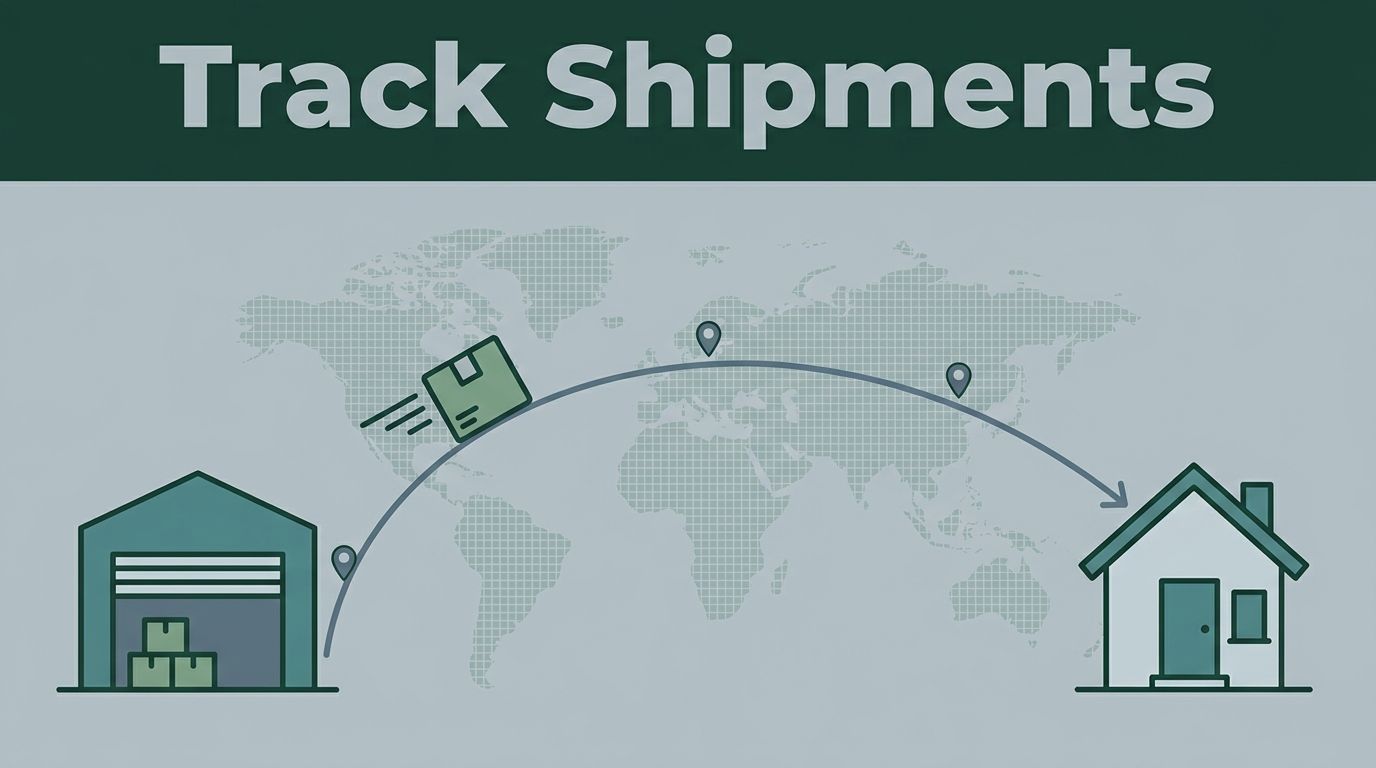
Have you ever ordered something online and then stared at the tracking page like it owed you an explanation? You’re not alone. With e-commerce volumes rising, shipment tracking from origin to destination has become part of the buying experience, not an extra perk.
In the US, 2026 is on track for about 24.6 billion e-commerce packages, which works out to 66.8 million delivered each day (roughly 773 per second). When millions of trips start and stop every day, tracking is what turns chaos into clarity. It also cuts down on the “Where is my order?” messages that often make up 30% to 40% of support tickets.
So how does tracking actually work once your shipment leaves the origin? Most systems follow the same core pattern. They attach an ID at the start (often RFID), collect location and scan events in the middle (often GPS and IoT), then generate delivery proof at the end. After that, systems use AI and sometimes secure logs (like blockchain-style audit trails) to reduce fraud and handle delays.
In this guide, you’ll see the step-by-step journey, the key tech behind GPS shipment tracking and RFID in logistics, how major carriers run it, and what’s changing in 2026.
The Step-by-Step Journey Your Package Takes
Tracking works because every stop creates a record. Think of it like a breadcrumb trail, except the crumbs update automatically across warehouses, trucks, and delivery routes.
Below are the main stages that your package goes through, and the types of signals that usually power each one.
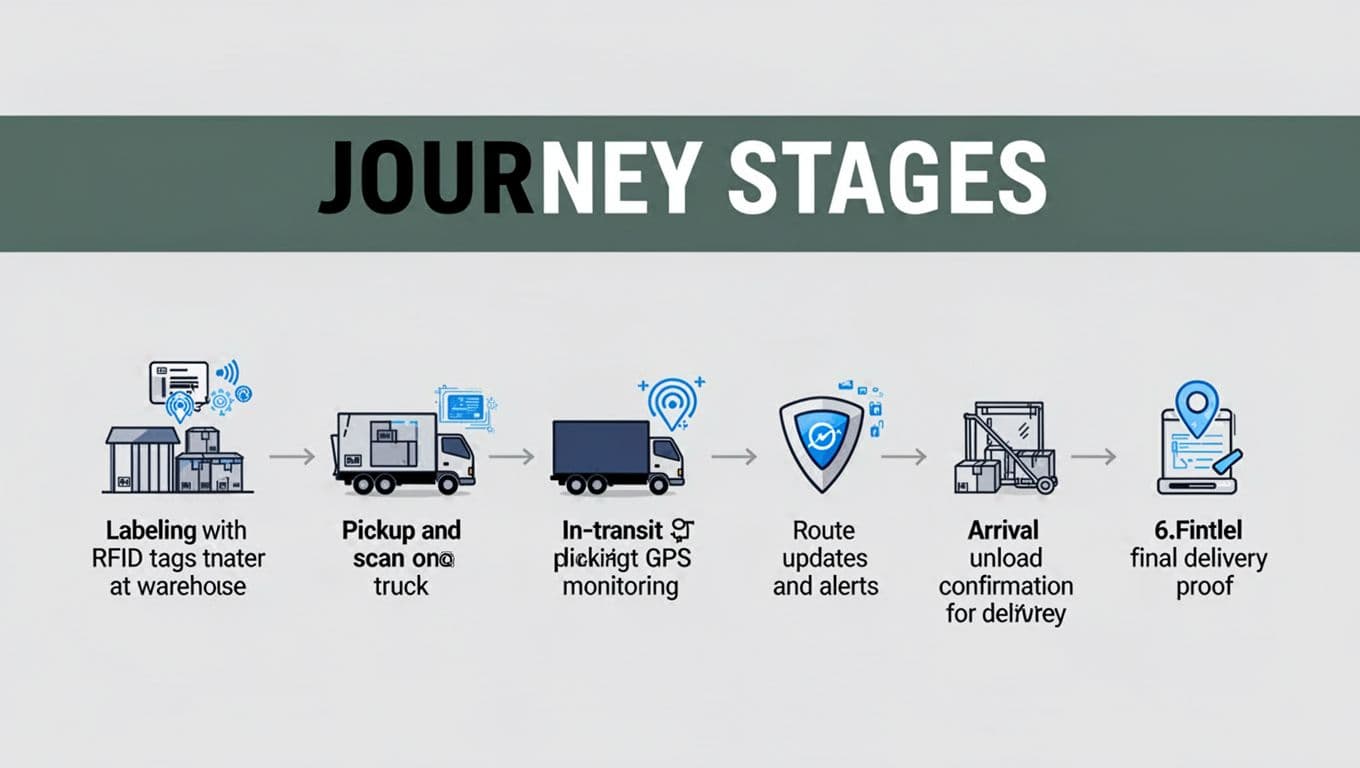
A simple way to picture it: your shipment gets tagged, scanned, watched on the move, checked for route changes, confirmed on arrival, then closed out with delivery proof.
Labeling and Tagging: The Starting Point
At the origin, workers or automated printers attach a label that includes a unique shipment ID. That ID connects your order to every later event.
In many setups, the label includes or pairs with RFID. RFID helps staff scan items fast without line-of-sight scanning. For higher value goods, you’ll also see trackers that include GPS, or at least a hybrid approach that blends GPS with Bluetooth (BLE).
Some systems use BLE labels on pallets or cartons. That’s helpful when packages travel inside a trailer. When BLE readers detect a tag, the system logs “this pallet is here,” even when GPS signal gets weak inside the vehicle.
Also, the tracking record usually stores more than location. It can include the service level, destination zone, and special handling notes (temperature control, fragile handling, hazmat rules). This matters because the system can switch how it monitors risk once it knows what’s inside.
In-Transit Monitoring: Eyes on the Road
Once the package is picked up, tracking shifts from “scan events” to “live monitoring.” Carriers and 3PLs track movement by using GPS shipment tracking on vehicles, plus device signals on pallets, containers, or trailers.
If your shipment uses IoT sensors, you may get more than location updates. Sensors can report conditions like:
- Temperature changes for food, medicine, or lab samples
- Humidity swings that can damage packaging
- Shock and tilt events that hint at rough handling
Meanwhile, BLE can confirm that pallets stayed with the right load. When readers inside facilities or on vehicle docks detect tags, the system can tighten the timeline for every handoff.
Then comes a powerful security tool: geofencing. A geofence is a virtual boundary around a route, facility, or time window. If the truck exits the expected area, or if a stop happens too early or too late, the system can flag it. That flag may trigger an alert, an investigation, or a route plan update.
If you want a broader look at how multi-signal tracking improves visibility across different modes, see multi-modal supply chain visibility across road, rail, sea & air.
Final Delivery Confirmation
Near the destination, tracking focuses on confirmation. That can mean:
- RFID or barcode scans at the final hub
- GPS checks for “vehicle arrived” events
- BLE reads to verify pallet or load presence
- Timestamped proof in the delivery system
For delivery, the carrier’s driver app often captures proof like a signature, photo, or “left at door” confirmation. That event then updates the tracking page automatically.
In some modern workflows, secure logging is used to make tampering harder. You might see blockchain-based audit approaches in the supply chain for chain-of-custody records, especially in higher-risk lanes. The goal is simple: the “who handled it” story should match the “when it happened” data.
Key Technologies Making Tracking Possible
Different carriers and logistics providers use different stacks. Still, most shipment tracking systems boil down to a few core technologies.
The tech doesn’t just show where a package is. It also helps systems detect risk, reduce claims, and protect the chain of custody.
GPS and Geofencing for Location Precision
GPS provides the baseline location. A vehicle sends position updates to a carrier platform, often every few minutes, sometimes faster. That feed powers live maps and helps calculate the expected arrival window.
However, GPS alone can struggle indoors, in dense city areas, or when signal drops. That’s why many workflows use hybrid approaches, like pairing GPS with BLE or using GPS on the vehicle plus location for facility events.
Geofencing adds rules. The system creates “expected” zones and time windows. When the vehicle hits the wrong zone, or pauses in the wrong place, the platform can raise an alert.
This is also where security and service reliability meet. If the system spots a deviation early, it can support faster actions, like contacting the driver, rerouting, or swapping a trailer.
IoT Sensors: Beyond Just Location
Location answers one question: “Where is it?”
Sensors answer another: “Is it okay?”
IoT sensors can report real-time conditions. For temperature-sensitive cargo, that means fewer surprises at delivery. Instead of finding out too late, teams can detect a temperature drift during transit.
Shock sensors matter too. A rough handling event can trigger a claim. Sensors make it easier to see whether damage happened during shipping, not after.
IoT tracking often connects to cloud dashboards. For context on how IoT and analytics show up in logistics tracking, check out IoT and Big Data in Logistics Tracking Explained.
AI and Blockchain: Smart and Secure
AI helps tracking handle volume and uncertainty. It can flag patterns that humans might miss, like repeated dwell times at certain stops or route deviations that often lead to theft.
AI can also improve predictions. If traffic, weather, or dock times tend to slow a lane, models can adjust ETA estimates. As a result, customers see fewer “it’ll be here tomorrow” loops.
On the security side, blockchain-style logs show up when stakeholders want a tamper-resistant audit trail. You typically won’t see this on every consumer tracking page. Still, the concept matters behind the scenes when multiple parties share custody.
If you hear the phrase “end-to-end visibility,” it often means combining positioning, events, and secure records across the full journey. For an example of that framing, look at end-to-end shipment visibility for real-time tracking.
How Major Carriers Track Your Shipments
Carriers track shipments using a mix of fleet telematics, facility scans, and partner systems. So while the tools differ, the logic stays consistent: record events, estimate ETAs, and alert on anomalies.
Here’s a quick comparison of how the biggest US names typically handle tracking.
What you can expect from UPS, FedEx, DHL, and USPS
| Carrier | What’s usually driving tracking | How it shows up for you |
|---|---|---|
| UPS | GPS on fleet, hub scans, routing updates | Live updates, proactive exception alerts |
| FedEx | GPS-based vehicle tracking, scanning at hubs | App notifications and ETA adjustments |
| DHL | IoT and multi-country visibility for many lanes | More frequent status changes on international routes |
| USPS | GPS and internal network scans | Tracking updates that follow USPS handoffs |
Takeaway: you’ll usually see a combination of vehicle location updates and facility scan events. That’s why tracking looks “busy” around hubs and “calmer” during long road segments.
If you ship across multiple carriers, you may also deal with tracking in different portals. Some tools help brands consolidate it. For background on multi-carrier tracking options, see multi-carrier tracking for UPS, USPS, and FedEx.
UPS-style tracking signals in practice
UPS tracking often leans on fleet telematics, because it’s built to manage trucks at scale. That helps with route changes and earlier alerts. When a truck gets delayed, the system can update delivery windows quickly.
FedEx tracking signals in practice
FedEx usually focuses on fast hub scanning and consistent route status updates. Their customer tools often aim to keep ETAs realistic during peak periods.
DHL tracking signals in practice
DHL’s strength is often visibility across international lanes. For cross-border shipments, tracking quality depends on customs handoffs. Better visibility tools can help reduce “tracking gaps” between countries.
USPS tracking signals in practice
USPS coverage can vary by service level and local network. Still, many updates are driven by scans at key transfer points, plus location data where available.
If you’ve noticed fewer updates on some USPS shipments, data access policies can play a role. For example, USPS has made changes related to tracking data access timing in some cases (useful context here: USPS to restrict package tracking data access starting in April).
Real-Time Features and Common Challenges
Real-time shipment tracking features sound simple. In reality, they’re hard to maintain across millions of events.
Still, customers get real benefits when tracking updates are frequent and accurate.
Top Real-Time Tracking Perks for Customers
Most tracking apps aim for three things: visibility, predictability, and alerts.
Common perks include:
- Live status updates that replace “stuck” messages
- ETA predictions that adjust when routes change
- Exception alerts for delays, missed stops, or address issues
- Package and sometimes pallet-level views for business users
- Proof of delivery timestamps, plus photo or signature evidence
When it works well, tracking becomes a calm signal. You don’t panic because you see the truck moving and the next handoff scheduled.
However, you’ll still see “processing” delays. Those usually reflect warehouse scan timing, dock batching, or carrier network congestion. In other words, the shipment may be moving, but your app updates when the system records the event.
Overcoming Tracking Hurdles Today
Tracking systems face real-world friction. Data comes from multiple sources, with different speeds and formats. Then fraud and theft attempts add pressure.
1) Theft and fraud risks
Criminals sometimes try to intercept shipments. That’s why AI-based anomaly detection, faster exception handling, and stronger ID verification keep growing.
There’s also a rising focus on “identity fraud” in logistics workflows, where a fake party tries to impersonate a carrier or shipping identity. Industry reports highlight how agentic AI could help with that type of risk handling. If you want an example of this angle, see Logistics 2026: Identity Fraud Surges & The Rise of Agentic AI.
2) Data overload
When you collect GPS points, sensor events, BLE pings, and scan logs, the platform can drown in signals. AI sorting helps. It groups events into meaningful status changes, so the customer sees “Out for delivery” instead of 60 sensor entries.
3) Cost for smaller shippers
Not every small business can afford pallet-level tracking hardware. That’s why some providers push lower-cost options, like disposable smart labels or simpler asset trackers.
For an example of how lower-cost labeling gets discussed for real-time tracking, see disposable smart shipping labels for real-time freight tracking.
Exciting Trends Shaping Tracking in 2026
Tracking is moving from “reporting history” to “taking action.” Instead of only updating a map, systems increasingly try to prevent problems.
In 2026, a few trends stand out.
First, agentic AI is getting attention. Agentic AI refers to systems that can take actions, not just flag issues. For example, if tracking shows a deviation, the system might initiate a reroute request, notify a risk team, or update downstream partners.
Second, pallet-level tracking is spreading. That doesn’t mean every consumer package gets a sensor. Still, more shipments get tracked at the load level, which improves accuracy when boxes move in bulk.
Third, sensor stacks are getting more practical. Instead of relying only on GPS, companies combine GPS with BLE and IoT sensors. That improves continuity when signal is weak.
Finally, more teams are pairing AI with security-focused audit trails. The goal is to keep chain-of-custody logs consistent across partners and borders.
If you want a snapshot of how AI and IoT are described as part of a 2026 “tech stack” for visibility, see AI & IoT: The 2026 tech stack for real-time supply chain visibility.
The big promise for customers is simpler than the tech. You should get faster updates, fewer blind spots, and more accurate ETAs.
Conclusion: From a Tracking Number to a Real Timeline
Your shipment gets tracked from origin to destination through a chain of records. It starts with labeling and tagging, then moves through scans and live monitoring, then ends with delivery proof.
Under the hood, GPS shipment tracking, RFID in logistics, IoT sensors, and AI predictions all work together. Each one answers a different question, so the tracking page stays useful instead of confusing.
Carrier networks then turn those signals into the statuses you see every day. When you use that information well, you can plan better, worry less, and contact support with details that actually help.
Next time you check your tracking app, look for the pattern behind the updates. Your package isn’t just “moving,” it’s logging every step. What’s the most satisfying status change you’ve ever seen, and what did it take to reach it?