Waiting on a package can feel like time moves in slow motion. You see the label, you track the status, and you still wonder, “When will it actually arrive?”
Air shipping promises speed, but the delivery date doesn’t come from guesswork. It’s built from flight schedules, ground movement, and risk buffers. Then modern tools refine those estimates as conditions change.
If you want delivery time estimates that you can trust, this breakdown will show you what shippers calculate, what can shift the timeline, and how tech in 2026 helps reduce surprises. Let’s start with the step-by-step process air shippers use.
The Step-by-Step Process Air Shippers Use to Predict Delivery Times
Air shipping estimates start with inputs. Then the carrier and forwarder math turns those inputs into a timeline. Think of it like planning a road trip, except you’re crossing oceans in the fastest possible way.
A common high-level formula looks like this:
Total delivery time = Trucking + Handling + Flight + Buffer
That buffer is the part most people ignore. It’s also where the estimate gets realistic.
Here’s where that workflow shows up in real quoting tools. For example, you can see how carriers explain estimated delivery times using tracking and service rules, like how to get an estimated delivery time for your package on FedEx’s guidance page.
Meanwhile, freight platforms often use a calculator approach for lanes and modes, like Freightos’ transit time calculator. It’s a good reminder that time estimates rely on lane data, not wishful thinking.
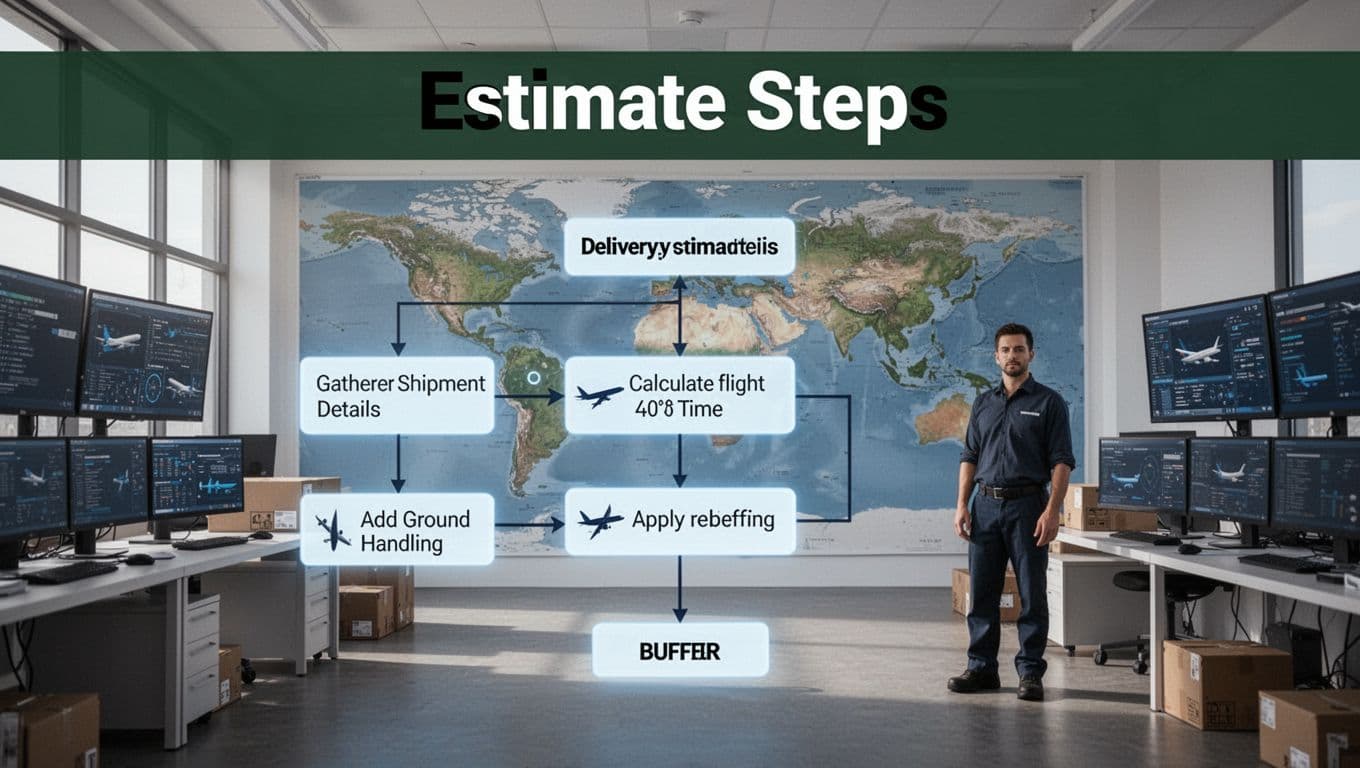
Next, the workflow turns into time blocks you can recognize.
Gathering Key Shipment Details to Kick Things Off
Before anyone estimates transit time, they need basic facts about your shipment. These details shape both the route and the handling steps.
Most systems request:
- Origin airport or pickup area
- Destination airport or delivery area
- Shipment weight and dimensions
- Package type (document, parcel, cargo, temperature-controlled)
- Service level (express priority vs. standard air cargo)
Once you enter those details, the tool can pull the lane’s likely flight options. It also estimates how long your freight sits in normal processing steps. Even if the shipment flies quickly, airport time and transfer time still matter.
Also, service level changes the plan. Express routes tend to prioritize faster acceptance and quicker transfer through hubs. Standard shipments can wait for the most cost-effective departure window.
In other words, the estimate depends on what your shipment “can fit into.” A heavy pallet and a small parcel rarely follow the exact same handling path.
Calculating Core Flight Time from Airport to Airport
Now comes the flight portion. This is the most intuitive part, yet it still has hidden complexity.
Air shippers estimate flight time using:
- Distance between origin and destination
- Typical route paths (direct or via a hub)
- Scheduled flight times and frequency
- Expected turnaround times at airports
Distance gives a baseline. Then route options refine it. A direct route usually wins. A hub route adds time because freight needs more than one departure.
That’s why two shipments with the same countries can still take different days. One might fly nonstop. The other might land, transfer, and then depart later.
At the practical level, you’ll often see express lanes cluster around a shorter business-day window, while standard lanes spread out more. The buffer also varies by how often flights run on that lane.
Adding Time for Ground Handling and Transport
Air flight time is only part of the timeline. Most delays start on the ground, even before the plane door closes.
So shippers add two ground blocks:
- Pre-flight trucking and handling
Pickup to the airport, plus packing and intake checks - Post-flight transport and delivery
Arrival airport to the final delivery location
Depending on the lane, these steps can total 2 to 4 days combined. For example, a supplier pickup might happen the same day. But the freight might not clear into the airport system immediately. Then it may wait for a scheduled acceptance or cutoff.
Also, “airport to door” can involve more than one move. A shipment might travel from the airport to a local service center, then to the final address.
So the estimate treats the plane like the fastest segment of a longer journey.
Applying Safety Buffers for Real-World Risks
Even the best schedule can get disrupted. That’s why most air shipping estimates include a buffer window. It accounts for uneven conditions, not for chaos.
Common buffer drivers include:
- Customs processing timing and inspections
- Weather rerouting or grounded aircraft
- Airport congestion during peak periods
- Missed connections on hub routes
- Documentation issues that cause hold time
Buffers help the estimate land closer to reality. They also explain why two shipments with similar flight routes can arrive on different days.
In plain terms, shippers don’t just predict flight hours. They predict the day-to-day friction around those hours.
For international door-to-door timelines, many shipments land in a broad 1 to 10 day window, especially when comparing express and standard services. But the exact range depends on customs, season, and how direct the lane is.
Main Factors That Influence Your Air Freight Transit Time
If you want to understand the estimate, focus on the biggest levers first. Air shipping often looks like a straight line on a map, but the timeline bends around real constraints.
Below are the main factors that shape your transit time, especially on international shipments.
How Distance and Routes Determine Flight Speed
Longer trips usually mean more time. That sounds obvious, but it’s more than just hours in the air.
Distance affects flight time, yes. Still, route structure matters just as much:
- Direct flights usually reduce transfer time
- Hub connections add waiting time for the next departure
- Flight frequency affects how quickly freight can move forward
Some lanes look short on a globe plot. Yet the fastest route might still pass through a major hub. That can add hours, then days, depending on departure schedules.
Also, direction matters. The same airports can have different flight patterns depending on the time of year and demand. So express can be fast one way and slower the other way.
Navigating Customs and Regulatory Holdups
Customs adds real time, even in air lanes. It’s not a small detail you can ignore.
Typical customs timing can fall in the 1 to 5 day range. Delays happen when:
- Documents have errors or missing data
- Inspectors select the shipment for review
- The destination port or processing center runs busy
- Trade rules trigger extra checks
If you ship internationally, clean paperwork is your fastest option. Even when the flight lands quickly, customs can control when the shipment moves on.
For broader context on how transit timelines vary by origin and process, see Dimerco’s guide to international freight transit times. It’s a helpful way to see how different steps affect arrival windows.
Weather, Volume, and Other Common Delay Makers
Weather is one of the most common real-world delay causes. Storms can ground flights, slow departures, or push aircraft to different routes. Seasonal patterns matter, too.
Volume and peak demand also matter. When many shipments move through the same airports, the system slows down. That can increase:
- Acceptance and intake queues
- Sorting and transfer delays
- Trucking capacity shortages
Then there are holidays and special events. Even without severe weather, demand spikes can stretch timelines.
Finally, aircraft type and service model can change outcomes. Express services often move faster because they prioritize fast handling and routing. Standard air cargo balances cost with speed, so it can wait for the best departure window.
To minimize impact, plan for buffers and choose the right service level early.
2026 Tech Innovations Sharpening Air Shipping Estimates
In 2026, air shipping estimates get smarter as data gets richer. Instead of using only static schedules, systems increasingly forecast what might happen next.
The goal is simple: reduce surprise. The method is not magic. It’s better data, better tracking, and faster updates.
AI Tools That Predict Delays Before They Happen
AI can flag risk early by looking at patterns across many shipments. It also blends historical data with live operational signals.
So instead of saying “the flight is scheduled,” AI can say, “this lane often slows on these days.” It can also check weather models and demand patterns.
For example, CargoAi has public reporting about AI predictive tracking to anticipate air cargo delays before they happen, in posts like CargoAi’s delay prediction announcement.
What matters for shippers is not the label on the technology. It’s the outcome: fewer late surprises and more accurate milestone timing.
Real-Time Trackers Keeping You in the Loop
Tracking isn’t new, but the quality keeps improving. Many shipments now include sensors and enhanced tracking data. That means better visibility into key milestones like:
- departure and arrival scans
- handoffs between facilities
- temperature or condition checks (for sensitive cargo)
- location updates across the route
When the system detects a hold, it can update the estimate sooner. Then your team can react faster, instead of waiting until the last scan.
So even if a delay happens, you usually find out earlier.
Teamwork Between Forwarders and Airlines
Estimates improve when carriers and forwarders share reliable planning data.
Forwarders typically:
- consolidate shipments
- book space on airlines
- coordinate pickup and handoff timing
- manage paperwork and documentation flow
Airlines typically:
- publish schedules
- adjust operations when flights change
- handle airport-side cargo movement
When those steps sync well, the timeline becomes tighter. When they don’t, time buffers have to grow to protect the delivery promise.
In short, tech helps, but coordination still drives most results.
Real Delivery Times on Popular Air Shipping Routes Today
Numbers help you plan better. Based on 2026 average expectations, here are typical business-day ranges for air shipping by lane and service type.
| Route | Express (business days) | Standard (business days) |
|---|---|---|
| US to Europe | 1 to 5 | 5 to 14 |
| US to Asia | 1 to 5 (often courier express) | 5 to 12 |
| China to Europe | 3 to 7 | 6 to 10 |
| Europe to US | 1 to 5 | 5 to 9 |
These are door-to-door style averages and can vary by airport, service setup, and season. However, they’re a solid reality check if you’re comparing options.
Also watch the direction and route type. A lane with frequent departures can beat a direct route with fewer flights. Seasonal demand can shift “average” by several days, even when flights still happen.
Finally, customs can swing the outcome. Even fast express flights can land and then wait for clearance. That’s why “flight time” and “delivery time” are two different things.
If you need urgent delivery, focus on express service plus clean paperwork. Then track the shipment after acceptance, not just after departure.
Conclusion
Air shipping delivery estimates come from a clear sequence: inputs, core flight time, ground handling, then risk buffers. That structure helps explain why your package can show “in transit” for longer than the flight itself.
Route choice matters, but so do customs timing, weather disruptions, and volume spikes. In 2026, AI-based forecasting and improved real-time tracking are making estimates tighter and updates earlier.
If you want to reduce surprises, use a transit time tool before you ship, choose express when urgency matters, and prep your documents carefully. Then keep an eye on live tracking so you can respond fast if conditions change.
Which part of the estimate do you usually watch most closely, flight time or customs clearance?